
Administrative Law Episode
Is Administrative Law Unlawful?
YES!
Hour 1
Viva & Barnes discuss the 5th Circuit’s ruling the SEC adjudications are non-Constitutional. This is huge and the backdrop for today’s lessons.
The video is cued to my audio lesson.
Below, the firearms case Barnes opens with.
The case below, by the 5th Circuit, knocks the hell out of the SEC’s administrative adjudications.
The “Regulation Freedom” Amendment and Daniel Webster
A failed end-run to make administrative regulations law.
“The politician that undertakes to improve a Constitution with as little thought as a farmer sets about mending his plow, is no master of his trade. If that Constitution be a systematic one, if it be a free one, its parts are so necessarily connected that an alteration in one will work an alteration in all; and this cobbler, however pure and honest his intentions, will, in the end, find that what came to his hands a fair and lovely fabric goes from them a miserable piece of patchwork.” Daniel Webster, 4th of July Oration, 1802.
We live in a time of constitutional illiteracy. A recent survey found that only 26% of Americans can name the three branches of the federal government. Yet every Tom, Dick, and Harry thinks he knows all about how to amend a document he never bothered to read.
https://www.renewamerica.com/columns/huldah/171129
Baltimore will no longer prosecute drug possession, prostitution and other low-level offenses
Prosecutors exceed the their constitutional boundaries.
“Prosecutors take an oath to uphold the constitution in the state of Maryland and the constitution (sic) says the general assembly sets the policy, not the prosecutors,” Cassilly told the station. “I respect the whole prosecutorial discretion. That’s not prosecutorial discretion, that’s an exercise in legislating. That’s what the legislature is supposed to do.”
https://www.cnn.com/2021/03/27/us/baltimore-prosecute-prostitution-drug-possession/index.html

5th Circuit Affirms Dismissal of Challenge to Congress’s Delegation of Smoking Regulations
Not the perfect case to knock it out of the park like Jarkesy v. SEC.
First, the appeals court held that “Congress undeniably delineated its general policy in the TCA.” They rejected appellants argument that the TCA’s purposes were “various and diverse,” citing in support that the section of the TCA covering this is titled “PURPOSE.” Second, the court held Congress “plainly limited the authority that it delegated.” The court reasoned Congress enacted a controlling definition of “tobacco product” so the secretary’s power was restricted to only products meeting that description. Furthermore, Congress also restricted the secretary by “making many of the key regulatory decisions itself.” Topping off their analysis, the court said “The relevant caselaw drives those conclusions home.”
https://lawstreetmedia.com/news/agriculture/5th-circuit-affirms-dismissal-of-challenge-to-congresss-delegation-of-smoking-regulations/
Nondelegation Doctrine
A Constitutional principle
The doctrine of nondelegation (or non-delegation principle) is the theory that one branch of government must not authorize another entity to exercise the power or function which it is constitutionally authorized to exercise itself. It is explicit or implicit in all written constitutions that impose a strict structural separation of powers. It is usually applied in questions of constitutionally improper delegations of powers of any of the three branches of government to either of the other, to the administrative state, or to private entities. Although it is usually constitutional for executive officials to delegate executive powers to executive branch subordinates, there can also be improper delegations of powers within an executive branch.
https://en.wikipedia.org/wiki/Nondelegation_doctrine
Administrative Procedure Act
The Administrative Procedure Act (APA), Pub.L. 79–404, 60 Stat. 237, enacted June 11, 1946, is the United States federal statute that governs the way in which administrative agencies of the federal government of the United States may propose and establish regulations and grants U.S. federal courts oversight over all agency actions. According to Hickman & Pierce, it is one of the most important pieces of United States administrative law, and serves as a sort of “constitution” for U.S. administrative law.
The APA applies to both the federal executive departments and the independent agencies. U.S. Senator Pat McCarran called the APA “a bill of rights for the hundreds of thousands of Americans whose affairs are controlled or regulated” by federal government agencies. The text of the APA can be found under Title 5 of the United States Code, beginning at Section 500.
https://en.wikipedia.org/wiki/Administrative_Procedure_Act_(United_States)
DHS v. Regents of the University of California
Notice the agency was acting to enforce Pres. Trump’s directives. The court overrides his executive power.
This, the Court says, violates a “foundational principle of administrative law” that bars ““post hoc rationalizations.” Further, the Court said, the government acted arbitrarily and capriciously in violation of the Administrative Procedure Act.
The Court reasoned that the DHS Secretary did not conduct a proper analysis of the entire DACA program because she relied on a conclusion by the Attorney General that only part of the program is legally defective.
https://www.subscriptlaw.com/blog/dhs-v-regents
Hour 2
Fifth Circuit Holds SEC Administrative Proceedings Unconstitutional
This is an excellent commentary on Jarkesy v. SEC discussed by Viva & Barnes. You can download the case’s opinion above.
On appeal, the Fifth Circuit sided with Petitioners on all three arguments.
♦ First, the court determined that the SEC’s agency-adjudicated enforcement action violates the Seventh Amendment’s guarantee of the right to trial by jury.
♦ Second, the panel held in the alternative that Congress unconstitutionally delegated its Article I powers by providing the SEC with unfettered discretion to choose the forum in which to bring enforcement actions.
♦ Third, the panel agreed with Petitioners that the statutory restrictions on the President’s ability to remove SEC ALJs contravene Article II’s Take Care clause.
https://www.ropesgray.com/en/newsroom/alerts/2022/May/Fifth-Circuit-Holds-SEC-Administrative-Proceedings-Unconstitutional
Article Two § 3 of the United States Constitution
Section 3 of Article Two lays out the responsibilities of the president, granting the president the power to convene both houses of Congress, receive foreign representatives, and commission all federal officers. Section 3 requires the president to inform Congress of the “state of the union”; since 1913 this has taken the form of a speech referred to as the State of the Union. The Recommendation Clause requires the president to recommend measures deemed “necessary and expedient.” The Take Care Clause requires the president to obey and enforce all laws, though the president retains some discretion in interpreting the laws and determining how to enforce them.
https://en.wikipedia.org/wiki/Article_Two_of_the_United_States_Constitution
Reynolds v. Kijakazi, No. 21-1624 (7th Cir. 2022)
The ALJ concluded that Reynolds was not disabled under the Social Security Administration’s five-step method and that Reynolds had the residual functional capacity to perform a full range of work with certain non-exertional limitations. The Seventh Circuit affirmed the denial as supported by substantial evidence.
https://law.justia.com/cases/federal/appellate-courts/ca7/21-1624/21-1624-2022-02-01.html
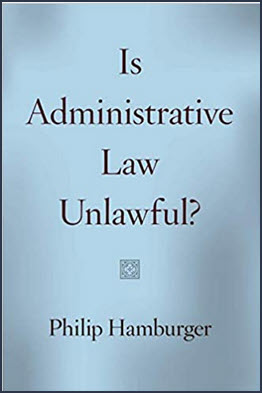
Is Administrative Law Unlawful?
YES!
The problem is not merely prerogative power, but absolute power. What Anglo-American lawyers typically discussed in terms of the “prerogative” was, in the broader sweep of legal theory, a question of absolutism. It therefore should be no surprise that when administrative power harks back to the prerogative, it also, more generally, echoes some basic features of absolute power.
♦ First, like the old absolute power, administrative power runs outside the law. Rather than work through ordinary law and adjudication, it proceeds alongside them, often mimicking their forms, but remaining different from them. In this sense, it is an extralegal mode of constraint, and it thereby evades not only the Constitution’s legislative and judicial powers but also its legislative and judicial institutions and processes and even many of its rights.
♦ Second, this power outside the law depends on judicial deference and it thus is not only extralegal but also supralegal. As in the past, a power exercised outside the law and the courts can survive only if the judges defer to it-only if they submit to it as power above their courts and the law. In this sense, administrative power is as much above the law as its predecessors.
♦ Third, among the effects of this power outside and above the law is the consolidation of power. The administrative regime consolidates in one branch of government the powers that the Constitution allocates to different branches. Although existing scholarship recognizes aspects of this problem, it does so mostly in terms of the separation of powers. The threat to the separation of powers, however, is merely one element of a broader consolidation of power, which results from the exercise of power outside and above the law.
Administrative power thus brings back to life three basic elements of
From Philip Hamburger’s, Is Administrative Law Unlawful? Page 6
absolute power. It is extralegal, supralegal, and consolidated .
Music and video credits
Danheim – Mannavegr (Full Album 2017) Viking Era & Viking War Music
https://youtu.be/8tilKaOINmE
Mason Proffit – Two Hangmen
https://youtu.be/CC3yZdG_2Bc
Copyright 2022. All rights reserved in print and audio content.